Is it possible for a fixer next door to make your home worth less? Or what if the house was in okay shape, but the yard was a disaster? I asked a handful of brokers and agents in the Sacramento area to chip in their two cents on how a fixer next door can impact a home’s value.

 Barbara Lebrecht: I tell my buyers the same thing I tell my girlfriends before making a big commitment. There are some things you cannot control. Don’t marry a property and expect the neighbor to change.
 Sarah Bixby: I’ll answer this from an investor angle. First, it depends on the neighborhood. Trying to sell a 500k+ home that sits next to a deteriorating fixer would definitely affect the aesthetic appeal and therefore the marketability of the home. In other lower priced neighborhoods I feel it’s more acceptable. If only the yard is unappealing, I would pay to have it landscaped and call it a day. If the home next door is a visible fixer I would still make the purchase but would have to take marketability into consideration and give a slight price reduction to compensate for the eyesore next door, or perhaps an extra upgrade or 2 that potential buyers couldn’t live without.
 Jeff Grenz: My flipper buyers had a rule to “never purchase next door to a cyclone fence” and also had me include a panorama of the adjacent homes as seen from the front walk for evaluation…. that would be “yes” from the flipper investor buyer.
 Kellie Swayne: Curb appeal is a significant piece to marketing any property. When surrounding homes appear unkempt and uncared for, buyers tend to notice. And, then they begin to worry about what kind of experience they might have living next to a home that is not well maintained. Whether buyers will pass on a house with a “fixer” next door likely depends on the overall neighborhood as well as the house that they are considering. And, how good of a fit the other pieces might be for them. I have seen buyers pass on a wonderful home because of unkempt homes nearby. And, I have seen buyers who are willing to overlook the “ugly ducklings” for the home of their dreams.
 Jay Emerson: I’ve had buyers say “I will offer less because of the neighbor”, “I don’t want that as a neighbor”, and “I can’t see it from my kitchen (I don’t care)”. So, beauty and appeal are truly in the eye of the beholder. It also depends on the market activity; in a hot market, the neighboring homes have less of an impact. Naturally, if the fixer also has squatters or boarded windows, it’s almost certainly a “drive-by”.
 Erin Stumpf: Every buyer has different peeves, but I’d say the average buyer definitely has an aversion to purchasing a home that is located next door or even within a close proximity to a blighted home. This is especially the case where the home buyer is planning to live in the home they are purchasing (versus an investment property they won’t personally live in). You only get one chance to make a first impression, and if a neighboring home is not well kept, then buyers tend to make certain assumptions about the occupants of the home without taking the time to actually investigate who lives there. If they don’t care to maintain the home’s outward appearance, what is going on inside the home? Are they hoarders? Do they have 25 cats? Will they be good neighbors? Will they be friendly? Occasionally in some neighborhoods, especially ones where homes are older, certain types of deferred maintenance in neighboring properties are a little more forgivable. But most of my buyers have opted not to offer on homes next to blighted property.
 Jennifer Klein: So much is about the neighborhood. In some cases the quality of the home does not matter if the neighborhood is undesirable. Unfortunately, one run down home can certainly effect the perceived value of the home as a reflection of the neighborhood. One bad apple can ruin the bunch!
Final Thoughts: Thank you everyone for such insightful comments. I sincerely appreciate your expertise. As an appraiser I also pay attention to location. Just as there can be a huge price premium when a street is tree-lined, it can also be damaging when a street has a beat-up feel to it. And a property can certainly sell for less because of a fixer next door. Usually this type of negative reaction in the market to a fixer is going to be worked out on the front end of a transaction when buyers are turned off by the issue(s) and the price is lowered until someone takes a chance – as opposed to an appraiser coming in and making some sort of objective blight adjustment. Other times though without the luxury of being able to watch a property being marketed, an appraiser is going to have to consider what is nearby and take that into consideration in the final reconciliation of value. Ultimately the saying rings true. You don’t just buy a home, you buy the neighborhood.
Questions: Would you buy a house with a fixer next door? Anything to add to the conversation?
If you liked this post, subscribe by email (or RSS). Thanks for being here.
 Steve Ostrom – Roseville Realtor:
 decrease in competition and increase in inventory makes it a great opportunity for buyers that feel a little tattered from recent market conditions.
 Angela Jones – Realtor:
 Keith Klassen – Realtor:
 Doug Reynolds – Realtor:
 Craig Dunnigan – Realtor:
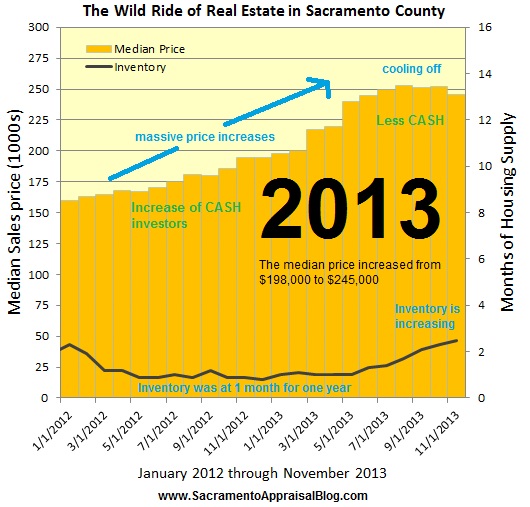
 Eric Peterson – Realtor: The market accelerated through the spring with higher than expected price appreciation across all segments. Unfortunately, on the 1st of July the market began to cool and once the numbers are in for the final months of 2013, I believe roughly half of the appreciation gained in the first six months of 2013 will have been given back in the second half of the year.
 Gena Riede – Realtor:
 Lori Mode – Realtor:

 When hunting for and evaluating homes for my flipper clients, garage conversions have a negative impact. In plain English, I calculate the cost to remove the conversion and restore the garage to original usage in 100% of cases. Why? Most conversions are unpermitted and ultimately that would have to be resolved. Most conversions are poorly executed, have issues with HVAC and access to bathrooms. Buyers want garages for vehicles and storage. While the conversion may have added temporary value for the seller, paraphrasing some of my favorite rock and roll: “you’re fooling yourself if you believe” it adds value for a buyer.
 I believe that if done well, they are a wash. They add some value by increasing the size of the home, but at the same time detract value by removing the garage. If done poorly, they can absolutely remove value. This includes if they are done with shoddy workmanship, but also if they are done when there is a lack of other parking or storage space. I have seen numerous examples of homes with converted garages that have little on street or driveway parking and/or have nowhere to store the junk that would normally go in a garage. If someone were to want to do a conversion, they should have ample additional parking and a shed or some other type of storage space for typically garage stuff. I also think that when people do a permanent conversion that removes the garage door and replaces it with an exterior wall, it definitely detracts from the curb appeal and lowers value.
 There are several factors that I take in to consideration when trying to determine what adds or subtracts value — OR — adds or subtracts to the desirability of a home in general. Best case scenario with a garage conversion that will add value = good workmanship, done with permits, and the presence of available garage parking that is consistent with the surrounding neighborhood. Worst case scenario with a garage conversion that will subtract value = poor workmanship, done without permits, and no available garage parking that is consistent with the surrounding neighborhood (See more of Erin’s thoughts on conversions
  I can definitely shed some light on how they could possibly add value, for the right buyer. I find that the older, tiny detached garages like ones found in East Sac or Land Park barely fit a car in them as is. When converted to a game room, man cave, or office, it creates a completely private place to escape to. The best example I can think of was an episode of Interior Therapy by Jeff Lewis. In the episode, Jeff converted a backyard garage into a home office and lounge type area. This garage was previously used as junk storage and by the end of the conversion you could see how much it brought to the property.
 In my experience, garage conversions typically do not add value to a home. Right off the bat, a large handful of buyers will not even be interested in the property if it does not have a garage. Therefore, the seller is missing out on about 60% of the potential buyers. So now your competition/interest in the home has already dropped. Next, the question screams: “Was it done with a permit?” Most of the time, garage conversions were not done with permits. This causes red flags for buyers and also eliminates more buyers who are using financing that will not allow non-permitted garage conversion purchases. Additionally, most garage conversions have a step down into the room and it typically does not “feel” like the rest of the house. Due to this, it does not add value for the extra square footage. You lose a garage and in place have not as good quality extra square footage. This leads to using the original square footage when trying to value the home with recent sales. With all of this factored in: In most cases garage conversions decrease the value of a home. At best, the conversion equally cancels out the loss of the garage. The only time it would add value is if you are adding a bedroom and/or bathroom that was done with permits, does not have a step down, the central heat/air is tied into the space and gives the same “feel” as the rest of the home.
 All I’d really say on the subject of whether garage conversions add value is: It depends. Are they common to the neighborhood? Some older neighborhoods of mostly two-bedroom homes have seen a large number of garages converted to additional living or bedroom space, and in neighborhoods like this it makes sense. Generally speaking, though, I think most people want a garage and are willing to double an office as a guest bedroom instead of looking for two rooms. More often than not when I take clients through homes with garage conversions I get comments like “this is kind of funky” and we have the discussion about how difficult it would be to convert it back to a garage.
 Buyers want bedrooms, bathrooms, nice living spaces and in most cases, a garage. In the past 12 years I’ve sold 3 homes with converted garages. These are their stories: 1) A single mother; 2) An investor looking for his next rental, and he liked the converted garage so he could charge more for rent (since it was called a “bedroom” – never mind that the driveway drainage was poor and it slanted down into the garage); 3) An elderly librarian who was also a first time home buyer, who had 12 cats. Yes, the converted garage was for the cats. So for those potential buyers, go ahead and convert those garages! Otherwise, please leave a garage as a garage. I haven’t even gotten into the hassle on the lending side if this conversion was done without permits. If you want to make your home appeal to the most buyers, and sell for more money, leave the garage intact.
 I think conversions would really be on a case by case basis… and mostly dependent on the needs of the buyer. I am a strong believer that each sale is unique, and if you are in the right place at the right time, you could sell a property for significantly more than you would at a different time. This definitely includes conversions, as some people try to maximize on their living area. Not having a garage though will definitely have a negative impact on the value. Another big factor would be the neighborhood. Many of the lower priced neighborhoods may even benefit from having a conversion (kind of like diluted price per square foot), so it may have a positive impact on the overall price. Higher end neighborhoods, however, don’t necessarily look at the total square footage to determine the price but more on the outlay, condition, and lot. It would also have a much larger negative impact in a higher end neighborhood as it’s not necessarily seen as “desirable” to live in a conversion. Maybe a cheaper alternative to an in-law quarter. 🙂
 As far as conversions, we usually convert them back. We’ve found that most people value a garage more than an additional bedroom. The need for extra storage space along with the reality that most conversions aren’t done very well leaves us converting about 90% back to garages.

 Please note if you have a chain link fence, nobody is targeting you or saying you’re bringing down the neighborhood. These are simply the opinions of experienced real estate agents and investors. Of course, it may be worth considering what they are saying since they are constantly buying properties to fix and sell on the open market. Clearly they’re in touch with the perceptions of buyers, what makes a difference in property value and the reality of how important impressions are for a neighborhood. If certain elements of fence design give off a negative impression for the community, what can be done about it? What options exist?