Let’s talk about choosing comps. I want to share an example of what I did not long ago when there were no recent sales for a unique model in a tract subdivision. Anything to add? I’d love to hear your take.

The situation: The subject property is a larger single story home with a casita. In this case the builder built only a handful of homes with a casita, so comps would be limited. If you aren’t familiar with a casita, it’s a term used to refer to an extra housing unit or detached area. I find it’s often interchanged with “in-law unit” or “accessory dwelling”, but we have to remember an accessory dwelling unit (ADU) actually needs a sleeping area, bathroom, and kitchen to be an ADU. In this case the “casita” only has a bedroom and bathroom, so while it’s tempting to call it an accessory dwelling, it’s really not because there isn’t a kitchen.
The problem: There are zero recent casita sales, so it’s not easy to readily understand what the market is willing to pay for one of these units. What do we compare the casita unit with in today’s market? How do we adjust for it?
What I did: In an ideal world I would’ve had a nearby neighborhood with casita sales, but I didn’t find anything, so I chose to study the neighborhood market by researching three casita sales in the neighborhood over the past ten years. As long as the data was good, I would use research from sales in the past to help me value a property today.

Immediately I noticed the casita sales were clearly commanding a price premium. I thought that this might be the case, but it was still good to confirm instead of assume. Keep in mind if you don’t know how to graph, that’s okay. You can see the same thing when pulling a CMA or printing out sales. Here is a tutorial though in case you want to learn to make a graph like this.

The next thing I did was to research how the casita units compared with other specific models at the time of their sale. Being that most casita homes were somewhere around 2500 sq ft (without the casita), I wanted to see how these units competed with other homes that were around that size. The beauty of having three older sales was I could find what the price adjustment was in each of those situations compared to other specific models. This would prove valuable since I had three recent 2500 sq ft sales without a casita, and I would need to make a value adjustment for the casita in today’s market.
I won’t say exactly what my adjustment was, though maybe I will in the comments.
The big point: Sometimes we have to look back in time to understand how value works. Don’t be afraid to pour through many years of sales to help establish context. Spend time answering the question, “How does a property like this fit into the market?” We can do this by scouring years of sales in the immediate neighborhood, but we might also look to the surrounding market too for competitive locations. Of course just because we research sales that are many years old does not mean we will use them in a current valuation (or a listing presentation for agents). I really don’t have a problem with using older sales when appropriate because we can always make an adjustment depending on how the market has changed over time. But let’s remember FHA wants appraisers to use comps within 12 months, so I probably couldn’t get away with using a sale from three years ago in a lender appraisal. However, I could pull in research from the past to help support the value for what the casita is worth.
I hope this was helpful or interesting.
Questions: Anything else to add? Did I miss something? When have you used older sales to help see the context of value? I’d love to hear your take.
If you liked this post, subscribe by email (or RSS). Thanks for being here.


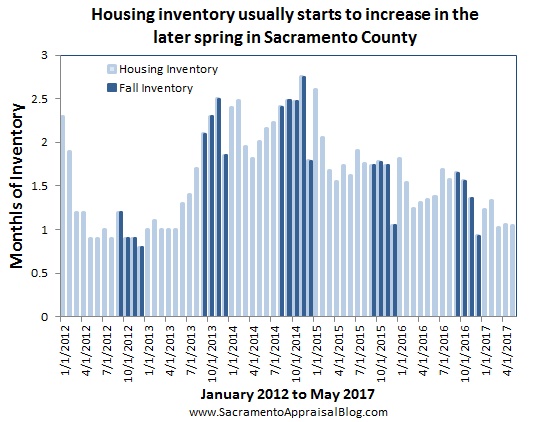
 If you didn’t know, sales volume last month was the strongest May we’ve seen over the past 4 years. But don’t get too excited because sales volume for the entire year is about the same as last year. No matter how we look at it, price metrics are up 7-9% from 2016 and they increased by 2-4% last month. One of the themes that won’t go away is we have a shortage of housing. In fact, housing supply is 22% lower right now compared to last year, and it’s been putting pressure on values to increase – particularly at entry-level price ranges. The tricky part lately is many contracts are getting bid up due to multiple offers (even beyond a reasonable appraised value). This can favor sellers accepting offers from buyers who have more cash to make up the difference between the appraised value and the contract price, though FHA sales stats show first-time buyers are still finding ways to close deals. In higher price ranges the market feels much softer, though we are still seeing multiple offers when properties are priced correctly. This is a good reminder that it’s possible for the market to feel more aggressive than actual value increases. In other words, having multiple offers doesn’t mean values are increasing rapidly or at all. Lastly, we are starting to hear more about lenders rolling out 100% financing to help buyers artificially afford higher prices (sounds healthy, right?). I could go on and on with words, but let me share some graphs to show the market visually.